
Roundabouts are the future
This form of traffic control popular, effective

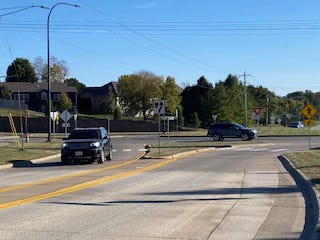
The funny thing about roundabouts, as traffic control devices?
They are not well accepted in many parts of the United States.
I offer a few examples, locally:
Davenport has established roundabouts in a few places, including Jersey Ridge Road, where I took the photo, above. There’s also a new one at the foot of the Arsenal Bridge. I know several drivers who try and avoid these locations.
Recently, City of Eldridge, Iowa, officials considered adding up to four roundabouts on LeClaire Road, which runs straight through town. I thought four was a bit much but one or two would work.
Of course, I don’t live in the Eldridge city limits and the proposal was shot down by officials who questioned the effectiveness, usefulness, etc.
Roundabouts are backed by sound science as far as I can tell.
The Iowa Department of Transportation lists a online page of myths about roundabouts and offers information.
To wit:
Roundabouts keep traffic moving, smoothly. Who hasn’t been caught at a stoplight, trying to wait patiently in line for traffic to move.
Yesterday, I had a near-accident when traffic, stopped at Utica Ridge Road and 53rd Street, prompted a woman driving a SUV to shoot in front of me, trying to get in the far lane of a three-lane locale. I kept an eye on the driver and obviously, didn’t have an accident.
That is the type of situation that is avoided in a well-placed roundabout.
Some folks might remember these traffic devices overseas, in Europe, or on the East Coast. For example: Washington, D.C. has many roundabouts and when we visited, years ago, we made our eldest sister drive our car. She was born in the area and was familiar with traffic control designs.
These days, the traffic flow has improved, and tackling a roundabout is much like taking a right-hand turn.
Roundabouts are more pedestrian-friendly. There is generally a large island in the middle, and folks crossing the street have a safer place to perch. This island often is surrounded by a bike path, or such.
The Insurance Institute for Highway Safety lists roundabouts as the best way to reduce vehicle crashes. If crashes do occur, they often are at slower speeds and vehicle damage is reduced.
Roundabouts are less expensive to build than tradition signal-controlled intersections, which require regular maintenance.
Most drivers are initially unfamiliar with roundabouts. But with use, many see the advantages of the smooth traffic control.
Properly designed roundabouts can accommodate larger truck or farm equipment traffic. Knowledgeable engineers would be familiar with that design, which often uses the interior island, or such.
Roundabouts are in our future, it seems. The time is right to learn how to use them, effectively.